 Save Upto 15% - 30%

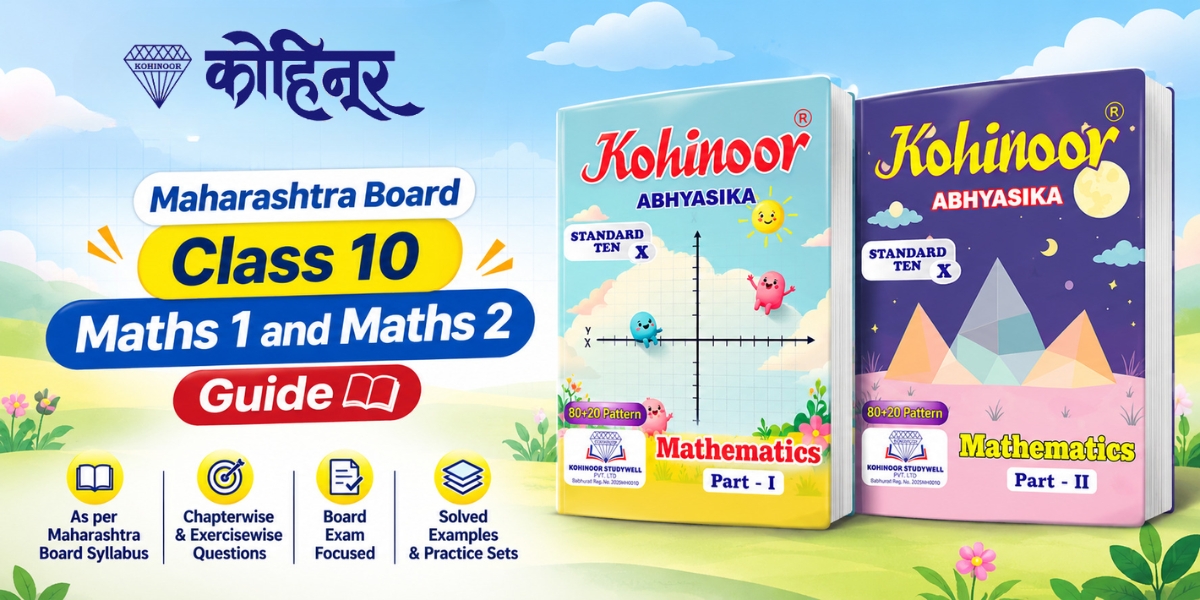
Maharashtra Board Class 10 Maths 1 and Maths 2 Guide: What Should Students Look For?
The Maharashtra Board Class 10 Maths 1 and Maths 2 Guide can be a useful study companion for students preparing for their SSC examinations. Class 10 mathematics requires more than memorising formulas. Students need to understand concepts, practise different question types, show accurate steps and manage their time during examinations.
For many students, Mathematics Part 1, which focuses on Algebra, and Mathematics Part 2, which covers Geometry, present different learning challenges. Choosing the right reference book can make daily practice more organised and help students identify areas that need improvement. But what should students look for before selecting a guide? A few important features can make a real difference.
1. Check Alignment with the Maharashtra SSC Syllabus
The first step is to ensure that the guide follows the prescribed Maharashtra State Board Class 10 syllabus for the relevant academic year. A book should cover the required chapters without leaving important concepts unexplained.
Students should also compare its contents with their school textbooks. This helps them avoid spending too much time on unrelated material while missing topics included in their actual course.
A useful guide should explain concepts in a sequence that supports classroom learning. It should also be easy to navigate, with clearly marked chapters, examples and exercises.
2. Look for Clear Algebra Explanations and Worked Examples
Mathematics Part 1 develops skills in algebraic calculations, equations, statistics and other prescribed areas. Students often struggle when they understand a formula but cannot decide how to apply it to a question.
Look for a reference book that demonstrates each step of a solution. Worked examples should explain how the question is approached, which formula is selected and how the final answer is calculated.
For better practice, students can look for:
Step-by-step solutions to representative problems.
Examples ranging from basic to challenging.
Practice questions that test different methods
Explanations of common calculation errors.
Instead of memorising solved answers, try covering the solution and solving each example independently. This simple habit helps develop confidence and problem-solving ability.
3. Evaluate Geometry Diagrams and Proofs
Mathematics Part 2 requires logical thinking, accurate diagrams and an understanding of geometric relationships. Topics such as similarity, circles, constructions and trigonometry, where included in the prescribed syllabus, require regular practice.
A good geometry reference should present diagrams clearly and explain the reasoning behind each step. For theorem-based questions, students should understand why a statement is true rather than simply memorising the proof.
Before choosing a guide, check whether it includes:
Clearly labelled geometric figures.
Stepwise theorem explanations.
Construction procedures in the correct order.
Numerical problems with complete working.
Practice exercises for applying geometric concepts.
Students should redraw diagrams themselves and write proofs without looking at the answers. This improves accuracy and makes revision more effective.
4. Choose the Right Language and Learning Format
Students learn differently depending on their school medium and personal comfort with mathematical terminology. A guide written in a familiar language can make difficult explanations easier to follow.
Before purchasing a book, confirm that the language edition matches your needs. Also check the print quality, readability, chapter organisation and whether formulas and diagrams are easy to understand.
Students who prefer independent study should choose material that explains solutions clearly without requiring constant assistance. However, a guide should support the prescribed textbook, not replace it.
5. Check Practice Questions and Revision Support
Regular practice is essential for preparing for the SSC board examinations. A useful study resource should offer enough variety to help students move from understanding a concept to solving questions independently.
Look for chapter-wise exercises, mixed practice questions and revision material that reflects the current syllabus. If sample papers or previous-year questions are included, verify their relevance and accuracy before using them.
Students should maintain a notebook for formulas, important theorems and mistakes made during practice. Revisiting this notebook every week can help identify recurring problems before the examination.
6. Build a Practical Mathematics Study Routine
Even a well-designed guide works best when students use it consistently. Divide study time between learning new concepts, solving problems and reviewing earlier chapters.
For example, dedicate one session to Algebra calculations and another to Geometry diagrams or proofs. At the end of the week, attempt a short timed test covering both parts.
After checking your answers, classify mistakes into three groups: concept errors, calculation errors and presentation errors. This makes revision more targeted than repeatedly solving questions you already know.
Conclusion
Choosing a suitable Maharashtra Board Class 10 Mathematics reference book involves checking syllabus coverage, clear explanations, worked examples, accurate diagrams and useful practice exercises. Students should select materials that match their learning needs and encourage independent problem-solving.
Kohinoor TEZ offers Maharashtra State Board study guides, including Class 10 Mathematics Part 1 and Part 2 options. Students can explore the available editions and choose the resources that complement their school textbooks and preparation routine.
The goal is not simply to complete a guide. It is to understand each concept, practise consistently and approach the SSC mathematics examinations with greater confidence.